Fine Arts
Fine Arts Courses
At Ursuline, being a well-rounded, educated woman includes learning the fundamentals of artistic expression. Courses in the visual and the performing arts provide the foundation for this expression and allow students to follow their interests to advanced levels of study.
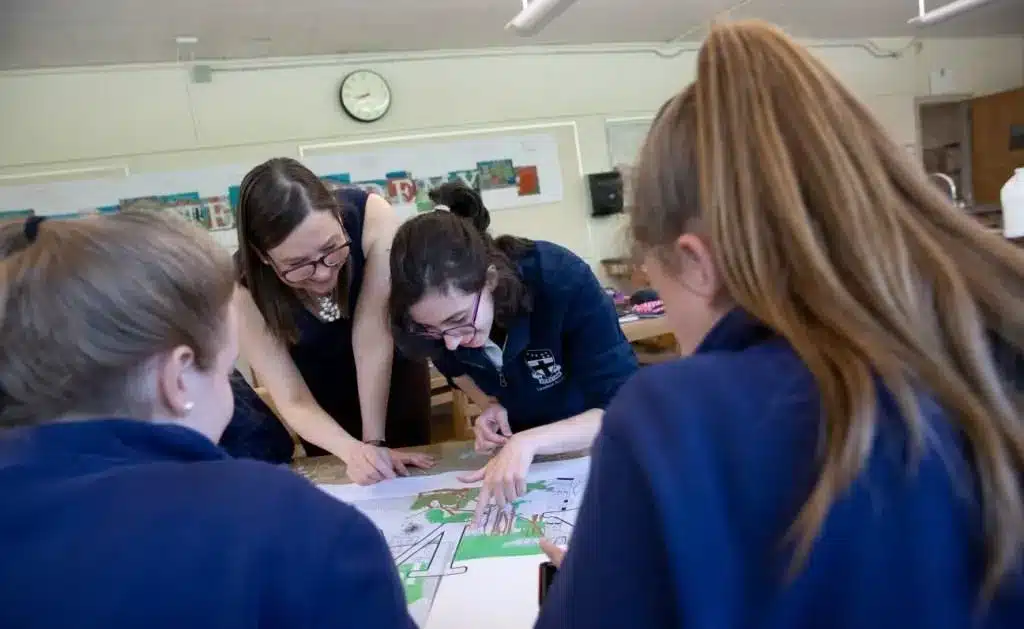
Visual Arts
The Visual Arts department faculty helps each student express herself artistically and creatively by developing her technical skills and imaginative ideation. Students hone their capabilities for observational learning and explore a variety of art media through hands-on projects that include training in and use of Ursuline’s tools for digital expression.
Art 7
In this course, students learn introductory techniques and the basics on which all future instruction rests: the color wheel, contour drawing, tempera paint, chalk pastels, introduction to drawing from a grid, and basic animation using the Animation Creator HD iPad app.
Art 8
In this course, students build upon and develop the skills learned in Art 7. Students learn about complementary and analogous color palettes, develop shading techniques, and begin drawing using classical perspective. Students develop observational drawing skills, study surrealism, and combine imaginative and observational drawing to incorporate ideas on dreams and subconscious to express meaning. Students then practice 1-point perspective, using the design process and envisioning by designing a dream room for themselves.
Visual Art and Design I
In this course, students are introduced to the Elements of Art (line, shape, form, value, color, texture, space). Students develop observational skills and strategies for drawing. Additionally, students learn the basics of color theory and visual composition, digital photography, Adobe Photoshop, painting, hand lettering, Adobe Illustrator, and Adobe In Design. Students explore realism, abstraction, and elaboration on a theme, as well as an introduction to Graphic Design. Understanding visual composition, color theory, and typography, students can proceed into upper level art classes.
Visual Art and Design II
In this course, students begin with a review of the Elements of Art and drawing exercises. This transitions into drawing from natural objects and an introduction to visual abstraction. Students elaborate on their drawings to create geometric or organic abstractions of their originals. Projects in this course include sculpture, landscape painting, printmaking, and collage.
AP Art and Design
In this course, students follow the curriculum as set by the College Board and may earn college credit through the submission of an Advanced Placement (AP) portfolio in the spring. Students develop their 2-D skills through materials and processes such as graphic design, photography, collage, printmaking, fashion illustration, and others. This course guides students to create artwork that reflects their own ideas and skills learned through the course. Students learn to investigate the materials, processes, and ideas that artists and designers use, practice the experimentation and revision process, and communicate ideas about works of art and design.
Website Design
Combining art and coding, students use graphic design and programming to connect left and right brain thinking in a practical, real world application. Students learn how to use principles of design to create a website and will gain the tools needed to implement their designs through code. They master HTML and CSS (and some Javascript), both of which languages provide a superior knowledge base in the web design field.
Senior Painting
This course is open to seniors only. There is no prerequisite, and as a result, it will include students with a wide range of experience. Students who have not taken an art credit are welcome, along with students who have completed one or two years of art. Students will work in a variety of media exploring color, value, composition, and light.
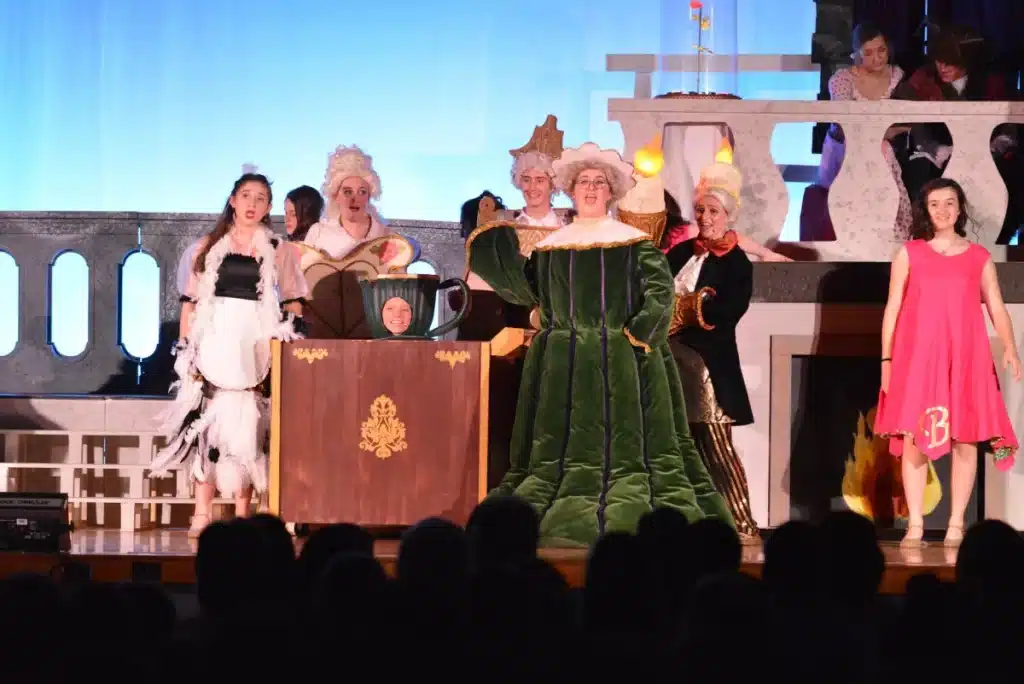
Performing Arts
Participation in the performing arts is a positive, whole-person endeavor that provides the student opportunities to take risks in a supportive environment. Performing arts provide an opportunity for students to develop and foster their communication skills, self-discipline, problem solving, teamwork, leadership, collaboration, and creativity, as well as to heighten their sense of self and the world around them.
Music 7
In this course, students will learn to be participants and listeners through an introduction to sheet music, percussion instruments, and vocal performance. Students will be encouraged to read and play rhythmic compositions, to work on keeping a steady beat, and reading and notating rhythms. They will be introduced to composition and arranging through the study of rhythm. Students will study music from the Western European Common Practice as well as Jazz and music from the modern age and will learn to analyze and critique these selections.
Music 8
In this course, students advance their musical competence by learning new time signatures, simple key signatures, and chords in major and minor keys. They use this information to compose a melody for xylophone or keyboard and accompany that melody on the ukulele. Students learn to play the varied repertoire of songs for the ukulele and put together a ‘band’ performance as their final assessment. As they listen to music, they continue to use their music vocabulary to analyze, describe, and evaluate performances from all eras and genres.
Music Theory I
While music is universally embraced as a human language, Ursuline students learn how to interpret that language through technical understanding. Students focus on time signatures, rhythm, understanding intervals, key signatures – major and minor, and harmony. Additionally students engage in ear-training, which includes interval recognition, rhythmic and melodic dictation, chord progressions, and cadences. Students’ culminating activities include two original compositions.
AP Music Theory
In this course, students follow the curriculum as set by the College Board and may earn college credit through the Advanced Placement (AP) exam taken in the spring. Students learn to recognize, understand, and describe the basic materials and processes of music. This course encourages students to develop skills by listening to, reading, writing, and performing a wide variety of music. Coursework includes musical concepts including pitch, interval, scales, keys, chords, meter, and rhythm. This course develops skills including singing a notated melody on sight, notating music by ear, and completing music based on cues, following common-practice style.
Drama 1
In this course, students are introduced to Theater Arts through the study of beginning acting techniques and practical application of theater skills. Topics covered include movement, voice, relaxation, concentration, performance, improvisation, character analysis, scene study, monologues, audition skills, stagecraft (lighting, set, sound and costume design), playwriting, and directing.
Chorus
In this course, students will be introduced to the benefits of choral singing by learning a variety of pieces taken from two, three and four part (SSAA) choral literature for women’s and treble choirs encompassing many historical and cultural periods. The course will focus on vocal techniques, good tone production, diction, posture, healthy singing and excellent breath support.
With these skills and an emphasis on reading music notation and sight-singing, students will learn to express feelings and emotions that words alone cannot.